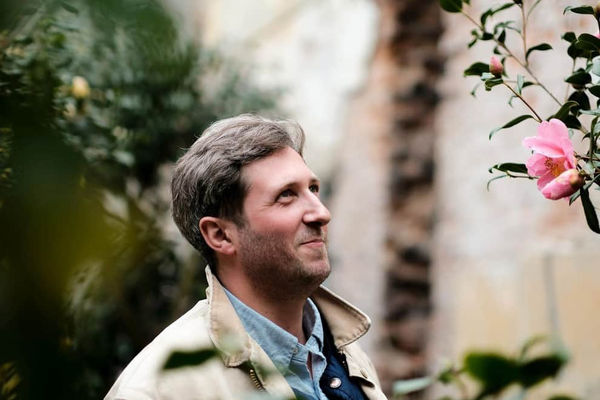
James Capper b. 1987
-
-
Download Artist's CVJames Capper (b. London, 1987) uses his background in agricultural mechanics to fabricate large-scale mobile sculptures. Trained as a welder and a graduate of the Royal College of Art, Capper's work combines drawing with speculative engineering and biology, producing mobile sculpture. These operate within 'divisions' of engagement with the world in Earth Marking, Aviation, Materials Handling, and Offshore environments. Each 'division' develops from a prototype, both technically and aesthetically, as Capper constantly experiments with new engineering solutions.Solo exhibitions of the artist’s work have taken place at Albion Barn, Oxford (2022); Alex Eagle Studio, London (2022); MONA, Barriedale (2021); Forth Arts Residency, Sydney (2019) Hannah Barry Gallery, London (2018); and Bathurst Regional Art Gallery, Bathurst (2017), among others. In 2020, the artist was commissioned by the Battersea Power Station to create MUDSKIPPER WALKING WORKBOAT, and in 2023 he was commissioned by Gallery Town to create Camellia. The artist participated in group exhibitions held at Hannah Barry Gallery, London (2022); Safehouse 1, London (2022); Alma Zevi, Venice (2021); Albion Barn, Oxford (2021); Serpentine Galleries, London (2018); and the Science Museum, London (2018), among others. In 2011, James Capper received the Royal Society of British Sculptors Bursary Award. In 2009 he was the youngest artist ever awarded The Jack Goldhill Prize for Sculpture from the Royal Academy of Arts and was nominated for the Jerwood Sculpture Prize. In 2023, Capper was the only artist presented at the Science Museum in an exhibition on leading engineers, globally. His work is held in the Science Museum’s permanent collection.
-
-
-
Heavy Metal
-
 James Capper, ALLO NIPPER, 2014
 -
James Capper, PELICAN JAW NIPPER, 2014
-
James Capper, PARROT JAW NIPPER 1, 2014
-
James Capper, JAWS, 2014
-
James Capper, PUSH AWAY TOOTH I , 2014–2016
-
James Capper, RIPPER TOOTH ORIGINAL, 2011
-
James Capper, RIPPER TOOTH Z, 2014
-
James Capper, ATLAS MILL C (VARIATION 3), 2016
-
James Capper, ATLAS MILL E, 2016
-
James Capper, ATLAS MILL K, 2016
-
James Capper, ATLAS MILL L, 2016
-
James Capper, ATLAS MILL O, 2016
-
-
CURVE-BASED SYNTAX
-
James Capper, GALACTICA, 2024
-
James Capper, GALACTICA PLUS, 2024
-
James Capper, NIRVANA, 2024
-
James Capper, HALO, 2024
-
James Capper, ROYAL ROMANCE, 2024
-
James Capper, CRESCENT, 2024
-
James Capper, LUNA, 2024
-
James Capper, YOU'VE GOT THE KEY DATES, 2021
-
James Capper, FIGHT FIGHT FIGHT + LOWER THE TEMPERATURE IN OUR POLITICS, 2024
-
James Capper, THERE'LL BE A BLOOD BATH IF HE LOSES + THEY FAN THE FLAMES OF POLITICAL VIOLENCE, 2024
-
James Capper, IT'S PART OF HUMAN NATURE + DISAGREMEENT IS INEVITABLE, 2024
-
James Capper, WE NEED TO GET OUT OF OUR SILOS + MISINFORMATION IS RAMPANT, 2024
-
-
Painting MachinesJames Capper's painting process
-
-
Animation of Tree PlanterCreated by Ryan Shao
-
Exhibitions
-
Past Exhibitions
-
-
MONITOR, Royal Academy of Arts, London, United Kingdom, 20 February 2024 - 28 September 2025
In autumn 2024, James Capper presented his new solo display MONITOR at the Royal Academy of Arts, showcasing the prototype for a major new sculpture project alongside recent artist drawings and a specially commissioned short documentary film. Held in the Architecture Window of The Ronald and Rita McAulay Gallery, MONITOR was commissioned by the Ukrainian arts foundation in exile, IZOLYATSIA, and is designed to serve as a nomadic studio for visiting artists in Kyiv. The project is a collaboration between Capper, designer Thomas Pearce, and architect Greg Storrar, continuing Capper's exploration of creating operational sculptures. The centerpiece of the exhibition was an eight-metre-long mobile sculpture with four hydraulic legs, inspired by reptilian movement, capable of navigating difficult terrains such as water and ice. A full-scale prototype of the structure’s wall, created using advanced robotic technology, was on display, demonstrating how the mobile studio could be used by artists to conduct expeditions and creative work in challenging environments.
The idea for MONITOR originated during Capper’s residency with IZOLYATSIA in Kyiv in 2018. Initially intended to explore the terrains surrounding the Dnieper River and Kyiv’s industrial areas, the project evolved after the Russian invasion in 2022 to reflect the need for mobile, resilient creative spaces. The design incorporates Capper's interest in human-machine interaction and biomimicry. The prototype’s walls feature integrated tools and furniture, making the structure a multifunctional space for artists. IZOLYATSIA and the MONITOR team are working to develop the project further, aiming to offer satellite studios to support the creative rebuilding of communities in Ukraine.
-
-
-
PROTOTYPES OF SPECULATIVE ENGINEERING, MONA, Tasmania, Australia, 2021-2022
Inspired by the movement of insects and evolution of vertebrae in walking species, Capper uses his ability as a steel fabricator and mobile hydraulics engineer to make sculptures that walk across landscapes. Their hydraulic systems hum into action, animated by complex problem-solving strategies and an artist driven not just to create but to understand.
And now to Broken Hill, Australia’s longest running mining town, where Capper’s sculptures navigate the outback—which you’ll see projected on the gallery wall and feel in the dirt beneath your feet—in a film made in collaboration with Australian filmmaker Alexander George. Here is a landscape and community shaped by mineral extraction, confronting our chequered history of industrial innovation, and ultimately, the cost of progress and an uncertain future. Capper draws inspiration from all over: from 450-million-year-old fossil footprints of creatures walking between freshwater pools in Western Australia, shedding light on how life transitioned out of the ocean and onto land; to Broken Hill’s cinematic terrain, from Mad Max to Wake in Fright; and even an ‘artificial cow’ that would carry food for an army on the move, built by Chinese commander Zhu Ge-Liang almost 1800 years ago.
-
-
-
AERO CAB, Verbier 3-D Foundation, Verbier, Switzerland, 24 June 2018 - 23 June 2019
James Capper’s work AERO CAB creates a modern platform for visitors to consider the role of the engineer in relation to creating solutions in fragile natural environments in places such as Verbier, and to the possibilities of broadening the scope from the technical aspects of engineering to those aspects that directly affect communities and the environment. Capper who is a pioneering artist and engineer known for his innovative approach to sculpture and machinery, made a significant contribution to the discourse surrounding climate change with his work, AERO CAB. Inspired by his explorations of glaciers and a profound concern for the environment, the artist embarked on a journey to merge art, engineering, and environmental activism. Capper's fascination with glaciers began with a desire to understand the impact of climate change on these majestic ice formations. Witnessing firsthand the alarming rate at which glaciers were receding due to rising global temperatures, he felt compelled to translate this experience into his work. His goal was not only to raise awareness about the plight of glaciers but also to inspire action through his art.
AERO CAB emerged as a culmination of Capper's interdisciplinary approach. It was a testament to his ability to blend aesthetics with functionality, all while addressing pressing environmental issues. At its core, the AERO CAB is a sustainable transportation solution designed to navigate the challenging terrain of glaciers while minimizing ecological footprint. The design of AERO CAB was both elegant and pragmatic. It featured lightweight materials and aerodynamic shapes inspired by nature, allowing it to glide effortlessly over the icy landscape. Powered by renewable energy sources such as solar and wind, AERO CAB is an example of sustainable innovation in transportation. James Capper's AERO CAB is more than just a mode of transportation; it is a catalyst for dialogue and action in the face of climate change in glacial environements. By harnessing the power of art and engineering, Capper demonstrated that innovative solutions are within reach if we are willing to confront the challenges of our time with creativity and resolve.
-
-
-
MUDSKIPPER, Thames River, Battersea Power Station, London, United Kingdom, 18 July - 4 September 2021
A former 1980s commercial Thames workboat, MUDSKIPPER, has been transformed by James Capper into a fully mobile sculpture (9.2 metres in length and 14.5 tons in weight), which has the ability to navigate across bodies of water and land the foreshore using a set of hydraulic jacks, offering passers-by the chance to see an experimental sculpture that crosses art, sciences and the speculative engineering divide. Inspired by the evolution of the vertebrates, and echoing the brave leaps made by those into a new and unknown world, MUDSKIPPER challenges and invigorates the definitions of engineering and art and the interconnections between the two.
MUDSKIPPER’s ability to change its environment, combined with its engineered hydraulic jacks for land-based locomotion, gives the sculpture a brave and exigent new character on the water. In line with Capper’s practice, the amphibious sculpture explores the dynamic relationship between biological ingenuity, biomechanics, and the human. MUDSKIPPER also points to a greater journey or mission, recalling the eccentric personas of Werner Herzog’s Fitzcarraldo or Wes Anderson’s Steve Zissou, and confronting the precarity of human existence and our contemporary technological desires.
-
-
-
TREADPAD, Albion Barn, Oxfordshire, United Kingdom, 2017
TREADPAD exists as both a sculpture and an attachment part. Designed for the use on Capper’s hydraulic sculptures, it is part of the WALKING SHIP family. The sculpture has two components, the cradle that the pads sit upon and the pads themselves. The former echoes an anchor, while the latter resembles a foot, thus a likeness is found between the mechanical and the biological. The cradle allows for the pads to be moved by crane or loader, hinting at the performative aspect of Capper’s sculpture: there is the stored potential of movement even while the sculpture exists as static.
TREADPAD features in Capper’s MUDSKIPPER commission.
-
-
-
DRAWING AND SCULPTURE, Albion Barn, Oxfordshire, United Kingdom, 8 April – 14 May 2017
DRAWING AND SCULPTURE is the largest presentation to date of the work of British sculptor James Capper (b.1987). Comprising more than 200 works, this exhibition examines in particular and in depth his use of drawing in the process of making sculpture. James Capper makes mobile sculpture to be used in action in a wide range of materials or terrains. His works are sculpture, and sculptural tools in – or ready for – action. Drawing is an important part of his practice and he makes large numbers of drawings of all kinds – from concept drawings (defining, developing and outlining new ideas and concepts for sculpture), technical drawings (line or filled-in drawings used to work out how the sculpture moves) to presentation drawings (spectacular, often large-scale, coloured drawings showing the sculpture in its complete form) and in-action drawings (complex drawings showing the sculpture in movement across space and time). In this way, for every realised sculpture there are a large number of drawings accumulated from conception to completion, as well as drawings made after the sculpture is finished; it is characteristic of James to draw his sculptures well beyond the fabrication period and even to return to specific sculptures through drawings years after they are made.
James Capper’s way of making mobile sculpture consists of three distinct but interrelated processes – drawing, making sculpture and the capacities and application of the sculpture in action understood and developed through testing, filming and subsequent demonstrations. His art adopts the techniques, materials and complex problem-solving processes of innovation and engineering to develop the possibilities of sculpture. His sculptural language evolves along different modular chains termed ‘Divisions’. Each sculpture produces questions that the next attempts to answer, so that over time each Division produces its own clear familial iconography and application in action. The works vary in size, from handheld Power Tools in the Carving Division to larger scale works sitting in the Earth-marking or Material Handling Divisions, and Offshore Division works envisaged for use on the water or Aviation Division flying works. Also, included in this exhibition are two large-scale outdoor works TELESTEP (2015) and TREAD TOE (2010), both from the artist’s Earth Marking Division, and a number of smaller scale works from his Carving Division including NIPPER (LONG REACH) (2012), a Hydraulic Power Tool from the family of sculpture defined by its distinct double “jaw”. The titles and forms of these sculptures are inspired by the living world of reptiles, insects and birds. However, considered in action their hydraulically controlled “teeth” – a term we now happily associate with James’ sculpture – demonstrate cutting and rapid fracturing capacities that seem entirely at the service of an industrial application. To consider his vision in short: traditional frames of sculptural reference are radically revisited, and if real-time technological advances in heavy industry fall behind or advance ahead, James’ own arrangement of ergonomics, hydraulics and aesthetics, allows the works to exist autonomously.
-
-
-
PROTOTYPES, Southwark Park Galleries, London, United Kingdom, 14 October - 6 December 2015
James Capper employs the techniques of industrial design to create sculpture in action. He designs and builds hydraulic machines that gouge, scratch and score the materials to which they are applied. They are both sculptures and sculptural tools in demonstration. Capper divides his works into four main ‘divisions’, each categorised by their function.
Capper’s hydraulic mobile sculptures are now internationally renowned, much for the sophisticated level of engineering they employ. PROTOTYPES surveys examples of prototype works developed by the artist since 2010, some of which have since developed into; monumental sculptural works. Prototypes mark a significant stage in the creative process the crucial stage in which a concept or thought materialises into matter, to be evaluated and tested towards the definition of a final form or purpose. This exhibition provides a rare insight into Capper’s sculptural language, exposing the often unseen drafts and stages of development which lead to his now infamous, sophisticated mobile sculptures which test the limits of mechanical engineering and our very understanding of functionality. CGP London has commissioned Capper to develop ATLAS Prototype. A new mobile sculpture developed in direct response to the unique in-situ poured concrete architecture of Dilston Grove. Throughout the exhibition we will watch demonstrations of ATLAS Prototype carve into its own plinth, turning over a period of time the cubed mass into a sphere. Resembling its namesake’s immortalised motif (Atlas the Titan was condemned by Zeus to carry the Heavens on his back for eternity, a legend often misrepresented by an image of Atlas carrying a globe on his back as opposed to the skies).
-
-
-
ATLAS A SPOLETO! / TELESTEP A SPOLETO!, Mahler and Lewitt Studios Spoleto, Italy, 25 June – 10 July 2016
James Capper brought two new sculptures to Spoleto – TELESTEP and ATLAS – for a residency with the Mahler & LeWitt Studios and an exhibition at the Festival dei Due Mondi. Capper’s sculptures employ the materials of mechanical engineering and the techniques of industrial design to develop the possibilities of sculpture and performance. Beginning with concept drawings, Capper designs and builds automotive machines that gouge, mark and score the materials on which they are used. They are mobile sculptures and sculptural tools in performance.
TELESTEP, from Capper’s ‘mountaineering’ division of sculptures, was displayed in a disused shopspace in Via Arco di Druso. It was shown alongside a film made on a mountain near Gubbio by Matthew Burdis during a residency with the Mahler & LeWitt Studios. The films shows TELESTEP being tested and demonstrated in the rugged Umbrian landscape. ATLAS is a mobile sculpture which operates from a concrete plinth. Over time it carves away at this plinth using specially designed mills. During the Festival dei Due Mondi, ATLAS moved between three concrete plinths placed at Basilica di San Pietro, Piazza della Signoria and the Rocca Albonorziana. At each site it spent several days carving its plinth. The sculptured blocks stayed In their locations for the duration of the Festival – either waiting for ATLAS to arrive, or showing the sculpted remains of the block on which ATLAS has already worked.
-
-
Press
-
11 art shows off the beaten track
Financial TimesElla Mansell, August 4, 2026 -
15 Questions with... James Capper
Go With YamoGary Grimes, July 13, 2026 -
Salvaged steel and a slice of countryside: Caro sculptures on show in Oxfordshire fields
The GuardianSteven Morris, July 3, 2026 -
'Organic' sculpture planned for market plinth
BBC NewsJohn Fernandez, March 31, 2026 -
Why James Capper is not just another artist
SHOWstudioChristina Donoghue, September 27, 2024 -
James Capper: CURVE-BASED SYNTAX
CURA.Caterina Avataneo, September 21, 2024 -
The top 5 museum and gallery exhibitions to see in London in September
FAD MagazineTabish Khan, September 14, 2024 -
Rotherham families have their chance to make mark on sculpture
The Yorkshire PostThe Newsroom, September 5, 2022 -
How To Make A Ship Walk - James Capper
Derwent LondonJanuary 13, 2022 -
Dreaming of hydraulic insects with James Capper
Artguide AustraliaSteve Dow, December 16, 2021 -
BRITISH ARTIST JAMES CAPPER UNVEILS MUDSKIPPER AT BPS
Battersea Power StationJuly 14, 2021 -
'My art has more pleasure in it now': How everything changed for three artists over lockdown
The StandardNancy Durarant, August 11, 2020
-