Rachel Rossin b. 1987
-
-
Download Artist's CV
Rachel Rossin (b. 1987, West Palm Beach) is an internationally renowned artist and programmer whose multi-disciplinary practice has established her as a pioneer in the field of virtual reality. Rossin’s work blends painting, sculpture, new media and more to create digital landscapes that address the impact of technology on human psychology, embodiment, sovereignty, and phenomenology. The New York Times has stated “Ms. Rossin has achieved something, forging a connection between abstract painting and augmented perception that opens up a fourth dimension that existed only in theory for earlier painters.”
Rossin's works have been exhibited at prestigious institutions around the world; including the Solomon R. Guggenheim Museum, Emerson Contemporary Museum of Art, KW Institute of Contemporary Art, The Whitney Museum of American Art, Kiasma Museum of Helsinki, K11: Shanghai, The Hyundai Museum of Seoul, HEK of Münchenstein Basel Switzerland, The Sundance Film Festival and The Carnegie Museum of Art. In addition to her artistic practice, Rossin has also lectured at Stäedelschule, Google, MIT and Stanford, and her work has been published in several notable publications, such as Video/Art: The First Fifty Years published by Phaidon, and Chaos and Awe: Painting for the 21st Century by MIT Press. Rossin's works are in the permanent collections of institutions such as Borusan Contemporary Museum of Art in Istanbul, The Guggenheim Collection, and the Whitney Museum of American Art. Her work has been widely covered in the press, including National Geographic, The New York Times, The BBC, The Guardian, Al Jazeera and Wired Magazine. Looking ahead, her work will be featured in a group exhibition at the Frist Art Museum in Nashville this autumn, followed by a presentation at the Guggenheim next year. Albion Jeune will also be presenting her work at The Armory Show in New York.
-
Antidotes
-
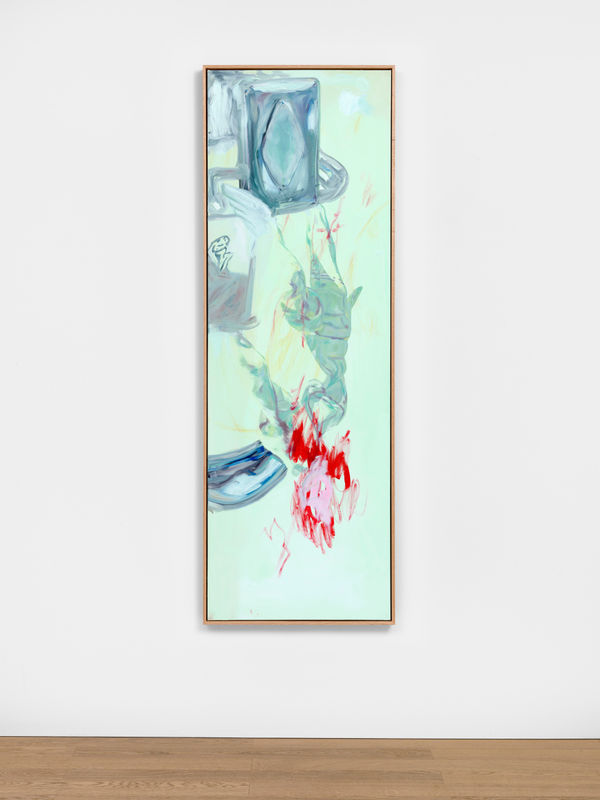
 Rachel Rossin, Brass Study, 2026
 -
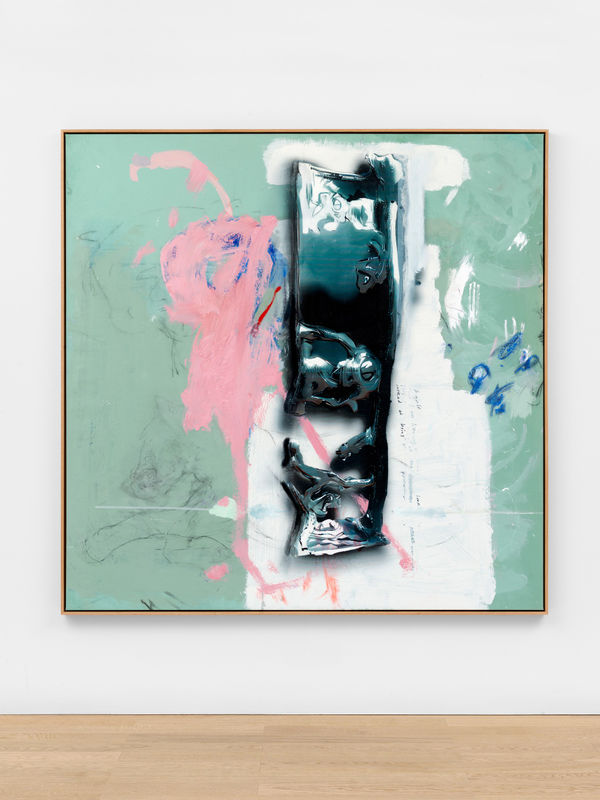
Rachel Rossin, Pink Diptych with Music, 2026
-
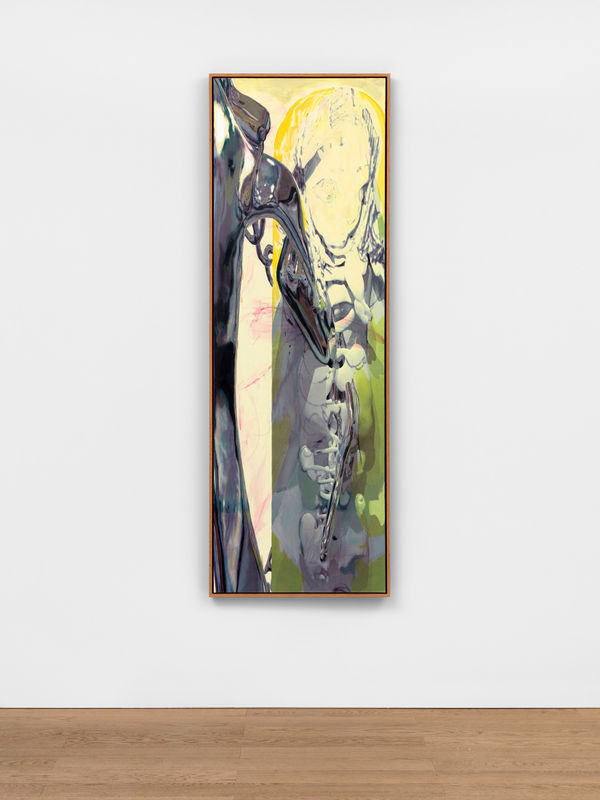
Rachel Rossin, Rilke and Calcite Sprite, 2026
-
Rachel Rossin, Gesture Copper Study, 2026
-
-
Rachel Rossin continues her ongoing Antidote series, a body of work that considers art as a means of countering what neuroscientists have described as “dark flow”, the cognitive and psychological effects of sustained technological exposure. Drawing on Rossin’s continued research with the Yale Brain Institute into long-form studies of technology use, the works explore the increasingly important role of art within a landscape saturated by information and digital stimuli.
Across the presentation, Rossin brings together painting, drawing and digitally generated imagery, combining physical and virtual processes. Her gesture-based practice begins with drawing sessions, from which forms are developed into digital models and brought into game engines, where physics, light and movement can be simulated. These virtual processes are then translated back into paintings, creating a dialogue between embodied gesture and computational systems.
In Rilke and Calcite Sprite, a digitally modelled sprite is painted using subsurface scattering, rendering the form to dually hold and disperse light. Drawings from Rossin’s studies sit within the background carrying a quotation by the poet Rainer Maria Rilke. Similarly, Me with Eutectics brings together digital modelling and the physical properties of light, drawing on ancient Sassanid glassmaking techniques while invoking the contemporary technological process of eutectic bonding used in the production of silicon chips.
Seven Self presents seven illuminated avatars, each initially rendered as a source of light, while Lapis-Levant-Lazurite draws together geology, poetry, history and painting. Ground lapis lazuli forms the basis of its ultramarine pigment, connecting the work to the ancient Sar-i Sang mines and to W. B. Yeats’s Lapis Lazuli, whose meditation on endurance and the choice of joy in the face of suffering informs the work. A horse, referencing historical apotropaic objects, acts as a protective figure.
Together, the works propose art as a space of attention, transformation and resistance: a way of slowing down, processing and finding new forms of perception within an increasingly technologised world.
-
-
The Totalists, II
-
Selected Works
-
-
Exhibitions
-
Past Exhibitions
-
-
Quickening, Solomon R. Guggenheim, New York City, NY, USA, October 20 2023 – April 7 2024
On April 2, 2024, the Guggenheim’s rotunda witnessed the collision of the physical and digital worlds as New York–based multidisciplinary artist Rachel Rossin transformed the iconic space into a hybrid environment. This impressive metamorphosis, supported by the LG Guggenheim Art and Technology Initiative, set the scene for the annual Young Collectors Council (YCC) Party.
Rossin integrates painting and sculpture with gaming, video, and emergent technologies to create what she calls “combines.” Widely considered a pioneer in the realm of virtual reality, Rossin produces works that allow physical traits to exist in digital environments and digital creations to take form in the physical world. In her exploration of the various intersections between these two realms, Rossin has on occasion looked inward to her own lived experiences and even her genetic material for inspiration.
-
-
-
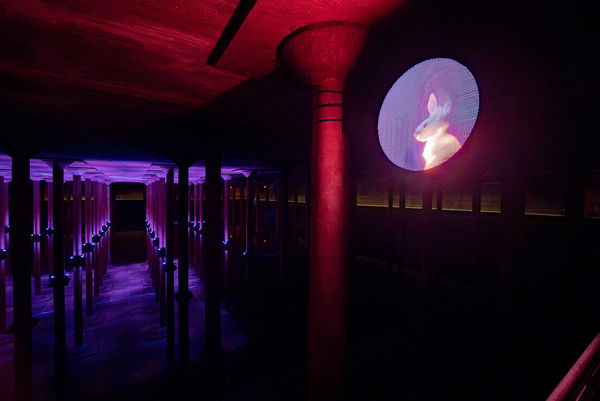
Haha Real, Buffalo Bayou Park Cistern Coalition, Houston, TX, USA, FEBRUARY 2 - NOVEMBER 10 2024
The original, site-specific installation by Rossin, titled Haha Real, transforms the Cistern into a three-act theater piece, drawing on both traditional art-making techniques and innovative technologies. Taking key inspiration from a diverse pool of influences, including Rossin’s favorite childhood story, The Velveteen Rabbit; the historic Marcel Duchamp lecture, The Creative Act, originally delivered in Houston; and the history and structure of the Cistern itself.
In The Velveteen Rabbit, the question “What is REAL?” is central. After the child who loved the Rabbit into being grows up and moves on, the Rabbit learns that “Realness” is both liberating and painful and is attained gradually over time through being loved (and ultimately lost) by another. Haha Real is a journey that unfolds over the course of a 30-minute visit around the quarter-mile diameter of the Cistern. As viewers circumnavigate the quarter mile Cistern, they stop at periodic “stations” where characters and symbols appear on LED holographic screens, while kinetic features and lighting augment the architecture of the space and the reflective surface of its water.
A high-fidelity score written by Rossin and performed by musician and sound artist, Frewuhn, accompanies the visuals, accentuating the Cistern’s 17-second reverberation. The end point of this journey is a cascade of uncanny sunsets within the darkness, hovering just above the reflective surface of the water inside the Cistern. Rossin is especially known for her use of technology, not only as a tool or medium, but as subject matter that helps us examine our relationship with our attention and autonomy. Rossin’s childhood voice, trained from recovered home videos using AI techniques, is heard throughout the installation. AI is also utilized in the visual elements of the work which are mixed with hand-drawn animation. The use of AI and virtual reality tools in the creation of the work furthers the artist’s inquiry into reality versus simulation. As a programmer and engineer, Rossin designs these systems herself, enabling her to embed meaning within the core components of the work.
The installation’s name, inspired by the first use of “haha” at the turn of the 18th century, refers to an awe-inspiring feature of European gardens that prompts viewers to exclaim “Ah ah!” The perceptual vastness provoked by the Cistern, a contemporary “Haha,” is both reflective of, and respite from, the persistent chaos of today’s technological quickening.
-
-
-
SCRY, Magenta Plains, New York, NY, USA, June 29 - August 11 2023
Magenta Plains is pleased to present SCRY, an installation and exhibition by Rachel Rossin including new paintings and transmedia objects. Building on her multimedia project The Maw Of, SCRY offers a new poetics and visual language for the next epoch in technology, offering a critical response on what painting is for and its enduring significance in our tech-dependent society. With the increasing existential threat/opportunity of artificial intelligence cresting over our collective horizon, Rossin postulates painting as a talisman of our inherent humanity and embodied consciousness.
SCRY is composed of three distinct bodies of work, each of which tackle different dimensions of our newly emerging era. Hanging from the ceiling of the gallery and bathing the entirety of the exhibition in otherworldly light, Rossin's lenticular LED screen The Maw Of continues her investigation into human autonomy and brain-machine integration research. Originally presented in digital and physical forms at the KW Institute of Contemporary Art in Berlin and the Whitney Museum of American Art in New York, The Maw Of situates the innate human desire to continually “remake” ourselves as central to the cultural inflection point represented by the advent of artificial intelligence.
Meanwhile, Rossin’s paintings offer a critical rejoinder to the promise and peril proposed by The Maw Of. Flesh and machine are hybridized in these works, as figuration simultaneously blends into abstraction. These images draw from Rossin’s childhood drawings of biblical figures associated with the apocalypse, generating a performance of Rossin’s own conception of “the end times.” Furthermore for Rossin, painting represents a marking of time on the canvas, a recording of the movement of the artist’s body. Despite the depth of discourse on this particular facet of painting, the humanness it implies continues to emphasize the relevance of painting as a practice and is a reminder of what endures the “annihilation of analog” represented by our increasingly tech-dependent culture.
These paintings are in conversation with Rossin’s small Scry Glass screens, distributed throughout the space. These works incorporate elements of the animation central to The Maw Of, and in doing so activate the characters and texture of the paintings. As their title suggests, the Scry Glass screens evoke two modes of looking: a form of divination and fortune-telling as well as a form of reflection using a Claude glass, a revolutionary tool used by 18th century landscape painters. For Rossin however, these “black mirrors” are not for predicting end times, but instead leave clues for the viewer, allowing us to remain tethered to the present.
-
-
Scry Glass II, 2023
Round LED display and microcomputer with digital colour video, silent, 9 min., 5 sec.
14.6 x 14 x 8.9 cm
Rachel Rossin’s Scry Glasses explore “Wireless Fidelity” signals and electromagnetic energy fields in our hyper-connected world. Rossin examines how the wasted energy that is facilitates the production of Wi-Fi exists as an untapped power source. Using this energy, Rossin proposes autonomous, self-powered sculptural-combines. They are self-contained and free-standing objects composed of microcontrollers and oragnic LED screens. The screens run visual images of an AI world programmed by the artist. The code itself varies according to the amount of the Wi-Fi energy that is harvested.
Rossin is a pioneer in the field of virtual reality, leading the artistic exploration of how artificial intelligence and virtual reality can contribute to the practice of fine art. This LED video project enables Rossin to draw out fundamental elements of this inquiry. The video blends figurative and abstract imagery, moving between fluorescent shapes and detailed depictions in a hallucinatory and evocative manner.
Rachel Rossin’s Scry Glass III, was acquired by the Guggenheim Collection for the first time in January 2026. Following her role in setting up the immersive space for the Young Collectors Council Party at the Guggenheim in 2024, supported by the LG Guggenheim Art and Technology Initiative, Rossin has enjoyed a close relationship with the Guggenheim. The acquisition of this work by the museum is a testament to the intriguing exploration of art and technology presented in Scry Glass.
-
-
-
Rachel Rossin’s The Maw Of is a transmedia story—a narrative unfolding across multiple platforms and formats—that reflects on the ways in which our bodies and minds are increasingly merging with and altered by technology. Central to the animation is a ghostly female figure, rendered in the style of Japanese manga, who wanders through a landscape of layered interfaces, symbols, and codes associated with technological and organic systems. Elements of content from whitney.org are combined with a graph of the nervous system and Web console exposing data operations, and parental guidance alerts give way to infrared imagery used for target acquisition in military operations. Viewers can use the on-screen QR code to launch the augmented reality (AR) component of the work and experience an additional layer of the narrative on their mobile devices. Synched with the browser-based animation, the AR layer features additional textual commentary and transports the central anime figure out of the browser window onto the viewer’s mobile device.
In The Maw Of, Rachel Rossin takes current research into brain-computer interfaces as a starting point to explore the historical development of the relationship between bodies and machines. The artist highlights how technology has evolved from its function as an extension of the body, enhancing its abilities, to more profound and invasive levels. Devices from smartphones to virtual reality headsets already mediate our personal and social lives, and research labs increasingly test the merging of hardware and living organisms. Rossin makes these developments palpable by weaving together visuals that capture an array of technological platforms in an experience mediated by screens, blurring the boundaries between digital and physical
-
-
-
-
The Maw Of, KW Institute of Contemporary Art, Berlin, Germany, 15 August - 18 August 2022
THE MAW OF by Rachel Rossin explores the coming together of flesh, machine, cognition, and code provoked by current research into brain-computer interfaces. An artist and programmer whose multi-disciplinary practice has established her as a pioneer in the field of virtual reality, Rossin’s work blends painting, sculpture, new media and more to create digital landscapes, which she uses to address aspects of entropy, embodiment, the ubiquity of technology, and its effect on human psychology.Spanning installation, sculpture, augmented reality, virtual reality, and net art, THE MAW OF features a site-specific installation at Tieranatomisches Theater (TA T), Berlin, as part of the digital program of KW Institute for Contemporary Art. Conceived as mixed-reality theatre, Rossin’s project stages a new conceptual and visual vocabulary, addressing the expanded limits of the human body and mind today.Imagining the corporeal as a component within a larger technical assemblage, the work draws from the historic development of body peripherals and outsourced sensing. Marshalling visual tropes from gaming, mobile apps, manga, and documentary video, Rachel Rossin’s work is a guided trip through the outer reaches of fantasy made real. Various icons are conjured along the way, like figures in a dream, that serve as symbols for prostheses used to augment our bodily existence. There are ‘sentinel species’ such as canaries, used to detect air toxicity in coal mines, or seeing-eye dogs, but also artificial devices such as smartphones and keyboards. Moving into the present, wearable exoskeletons represent an instance where hardware and wetware (flesh) increasingly meet. Many such technologies are currently being tested on animals before being implanted into the human brain—further intensifying the reality of cognitive peripherals.The online artwork — co-commissioned by KW Institute for Contemporary Art, Berlin, and the Whitney Museum of American Art, New York, and accessible on the websites of both KW (between 14 September and 21 October 2022) and the Whitney Museum of American Art (September 2022 – ongoing)—is an interactive feedback loop between the visitors’ screens and their mobile phone displays. Offline, at Tieranatomisches Theater, Rossin’s virtual reality environment morphs 3D scans of the theatre with the lobby of Whitney Museum and terrain features appropriated from a video game. Inside this environment, visitors chase an avatar, as a ‘ghost in a machine’, while it searches a network of tributaries representing their nervous systems.
-
-
I’m my loving memory, Huyndai Musuem, Seoul, Korea, 2020-2021
I’m my loving memory consisted of melted, printed plexiglass sculptures bearing imagery derived from virtual worlds of the artist’s making. Slices of verdant landscapes and fragmented creatures populate these worlds, combining digital painting with found and modified 3D models.
Taking cues from plein-air painting and videogame culture, Rossin captured views of these fragmented landscapes and prints them on clear acrylic sheets. She then melted them with a blowtorch and shapes them around herself while holding various poses.
The process evokes the way in which 3D frames are textured with digital skins, and the interplay between bodily experience and virtual worlds. The virtual worlds used as source material for these sculptures are integrated into the installation via an AR app.
-
-
Rachel Rossin for Art21 and CHANEL Culture Fund’s original series of documetary shorts, ‘IRL/url’.
Featured in four parts, Rachel Rossin discusses her life and work, spanning the physical and digital words. ‘IRL/url’ presents Rossin’s practice in a new light, demonstrating her perspective, her use of technology, and her approaches to art.
The short films are available on Art21’s TikTok, Youtube, and website. -
Part 1 of 4
-
Part 2 of 4
-
Part 3 of 4
-
Part 4 of 4
-
Press
-
Which Artists Have Joined Guggenheim Museum's Collection?
OculaMisong Kim, January 28, 2026 -
How Rachel Rossin Finds the Emotion in Technology
The CutAemilia Madden, January 26, 2026 -
Chanel Partnered With Art21 to Make a TikTok Series That’s Aimed at Much More Than Going Viral
CulturedSam Falb, January 26, 2026 -
8 Artists Who Made It Big in 2016 Remember the Year
ArtsyAlina Cohen, January 23, 2026 -
Rachel Rossin's Disembodied Drift
hubeJulia Silverberg, December 9, 2025 -
10 Years Into CULTURED’s Young Artists List, Alums Share How Their Careers Have Changed
CULTUREDElla Martin-Gachot, November 29, 2025 -
Meet the New York-based artists destabilising the boundaries of society by Hannah Silver
WallpaperJuly 11, 2025 -
2025’s Wallpaper US issue is on sale now, celebrating creative spirit in turbulent times by Bill Prince
Wallpaper USJuly 10, 2025 -
Rachel Rossin’s Theology of the Machine
ArtReviewAlexander Harding, June 26, 2025 -
Art Exhibitions in London: Base Materialism
MutualArtJune 13, 2025 -
London Gallery Weekend: A Snapshot of some favourite shows Nico Kos Earle
ArtlystNico Kos Earle, June 12, 2025 -
London Gallery Weekend 2025: An Alphabetical Guide to Essential Exhibitions
ArtlystJune 5, 2025 -
Rachel Rossin: The Mirror is Cracked
A Rabbit's FootLucca Hue-Williams, June 5, 2025 -
'Getting rich quick is out of the questions': what does it take to open a gallery in London these days?
Financial TimesMelanie Gerlis, June 4, 2025 -
London Gallery Weekend 2025: our critics pick their top shows by Ben Luke and Louisa Buck
The Art NewspaperJune 4, 2025 -
What to See During London Gallery Weekend 2025
FriezeThomas McMullan, June 3, 2025 -
Shownews: The Transformative Power of Libido, A Life Well Lived, the Female Form and More
SHOWSTUDIOChristina Donoghue, May 30, 2025 -
Art Doesn't Ask for Your Data
Twist MagazineFin Cousins, May 22, 2025 -
Viewing Rachel Rossin: The Totalists at Albion Jeune
The WickMay 2, 2025 -
The Totalists at Albion Jeune
SHOWStudioChristina Donoghue, April 30, 2025 -
How Young Artists Take Inspiration From Religion in Uncertain Times
New York TimesTravis Diehl, July 13, 2024 -
Artist Rachel Rossin Dazzled Guests of Guggenheim’s YCC Party
CultbytesAnna Mikaela Ekstrand, May 9, 2024 -
Artist Rachel Rossin Transforms the Guggenheim’s Iconic Rotunda
Cool HuntingDavid Graver, April 8, 2024 -
Rachel Rossin Builds Theatrical Underground Worlds
Surface MagazineJesse Dorris, February 26, 2024 -
Rachel Rossin: Haha Real
E-fluxFebruary 9, 2024 -
‘It Always Comes Back to My Own Embodiment’: Watch Rachel Rossin Explore the Slippage Between Physical and Virtual Realities
ArtnetCaroline Goldstein, August 1, 2023 -
Rachel Rossin
CURA.37Lola Kramer, December 1, 2021 -
There is something delightful in how frail technology is, it teaches us something about ourselves
FriezeMay 2, 2019 -
Rachel Rossin
ArtforumNovember 1, 2017
-