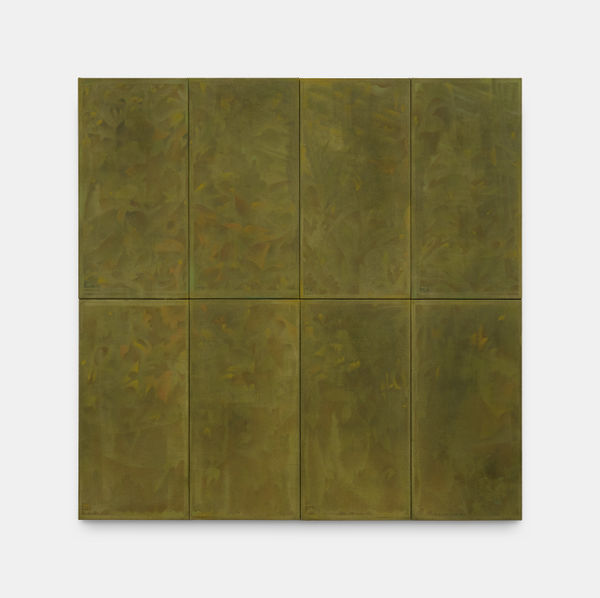
Xiaochi Dong b. 1993
-
-
Download Artist's CV
Xiaochi Dong (b. 1993, Shanghai) is an artist based between London and Shanghai whose practice bridges classical Chinese painting and Western contemporary art. A graduate of the Shanghai Academy of Fine Arts and the Royal College of Art, Xiaochi draws from a wide range of references including traditional Chinese gardens, the greenhouses in Kew Gardens, and Derek Jarman’s Prospect Cottage. Through these physical spaces, he explores the simulation, compression, and transformation of nature, drawing connections between real and artificial landscapes. His work reflects a deep engagement with the aesthetics, and often specific dimensions, of constructed ecosystems and how these echo classical Chinese landscape painting.
Xiaochi’s work has been presented at Hive Center for Contemporary Art, Beijing (2025); Altman Siegel, San Francisco (2025); William Hine, London (2025); Tank Shanghai, Shanghai (2024); The 24 Windows (2024), The Swatch Art Peace Hotel, Shanghai; Lychee One, London (2024); and THE SHOPHOUSE, Hong Kong (2024). In 2023 his work featured at Nan Ke Gallery, Shanghai; at ART021 Shanghai Contemporary Art Fair with both Hive Center for Contemporary Art and Nan Ke Gallery, Shanghai; Sherbet Green, London; Studio West, London; Pearl Art Museum (PAM), Shanghai; the RA Summer Exhibition, Royal Academy of Arts, London; and Split Gallery, London.
-
-
-
Selected Works
-
Exhibitions
-
Past Exhibitions
-
-
Symbiotic friend, Hive Center for Contemporary Art, Beijing, China, 8 March - 5 May 2025
How other species spend their lives, within the confined limits of lifespan, we are presented the possibility to enduringly observe them over relatively long periods. This prolonged observation also offers insights into ourselves, and is not about establishing a hierarchy among species, manipulating others, or separating culture from nature; instead, it reveals a deeper connection between our embodied awareness and acceptance. True acceptance transcends merely accommodating another being in your space or forcing a connection with it. It involves creating environments where these beings can thrive. Just as adaptation is a crucial survival skill for people in society, maladaptation reflects the fundamental and straightforward statement of plants and animals. To genuinely understand a plant, raise a poison dart frog, or cultivate a garden in the wilderness, we must consider specific factors like climate, temperature, nutrition, and viruses. This requires us to reconsider how we could allocate land and resources that we currently occupy, to truly learn from the lives of the other rather than using it as a tool for cultural exemplification, and to evoke a de-conceptualised, de-imagery way of thinking.
Dong’s works embody such logic of nature. The paintings are a diary of his observations – first blending the akadama soil at the bottom to obtain a natural base colour of everything, then outlining and sweeping the surface with an ink brush, placing objects that are suitable for growing in the right conditions, then waiting for them to blossom (with the pigment powder) if the sunshine is good. The colour threshold, the granularity of the arrangement, and the thickness of the powder all become important components of the painting, which is then revealed as a gradual composition of the familiar things prompted by these restrained and tangible choices and actions.
-
-
-
Petrichor, THE SHOPHOUSE, Hong Kong, ChinA, 24 Feb — 17 Mar 2024
THE SHOPHOUSE presents Xiaochi Dong’s first solo exhibition in Hong Kong Petrichor. The exhibition explored artificial landscapes at multiple scales including traditional Chinese gardens, botanical collections and miniature ecosystems. Through these environments Dong examined ideas of simulation, imitation and the compression of nature.
The works brought together painting and mixed media, creating atmospheres saturated with light, humidity and shifting air. Influenced by the traditions of Chinese painting in both technique and subject matter, Dong translated motifs such as clouds, bamboo and foliage, each carrying mythological and cultural significance, into ambiguous and dreamlike imagery. The compositions resist permanence as brushstrokes disperse across the surface while blank space evokes stillness and pause. Trees and mountains dissolve into abstraction, suggesting phenomena that hover between the recognisable and the indeterminate. This sense of flux invites the viewer’s imagination while reflecting nature’s own continuous transformation.
-
-
-
Enrichment, Nan Ke Gallery, Shanghai, China, 07 Nov — 10 Dec 2023
Enrichment presented the work of Xiaochi Dong and Di Yang in dialogue across painting, installation and video, intricately arranged within Nan Ke Gallery’s expansive space. While each artist expressed distinct philosophies and styles, the exhibition revolved around the shared theme of “enrichment,” exploring the paradoxical yet symbiotic relationship between internal self-awareness and external reality.
The title Enrichment originates in zookeeping, where it describes methods of stimulating captive animals to engage in natural behaviours by introducing props, food, scents and other factors into their environment. Within the exhibition, the gallery space itself became a kind of ecological tank. Here, enrichment was not only applied to the artworks and their placement, but also to the artists themselves. The installation unfolded vertically, evoking humanity’s arboreal nature as descendants of primates. The works of the two artists were distributed at different heights, creating a layered territory that underscored their distinctions while weaving a unified core throughout the exhibition’s pathways. The curatorial concept stemmed directly from Xiaochi Dong’s own artistic philosophy. For him, the ecological tank has long served as a subject of fascination: an artificially created environment that simulates behavioural adaptation while maintaining greater stability than pristine wilderness. In Enrichment, works on the gallery’s second floor emulated the forms of tropical plants within such a tank, offering viewers a perspective that shifted from interior to exterior.
This reflected a development in Dong’s practice. Early works took inspiration from greenhouse environments such as Shanghai Botanical Garden and Kew Gardens in London, where observation occurred from the outside looking in. More recently, he turned inward, focusing on the ecological tank in which he kept poison dart frogs in London. Through this lens, he inverted the act of observation, scrutinising the so-called “real world” from the inside out. Dong’s education in traditional Chinese painting in Shanghai profoundly informs his artistic language. His delicate brushwork of mountains, rivers, trees and stones merges with pointillist elements from European painting, producing subtle textures that combine Eastern and Western sensibilities. By incorporating materials such as volcanic ash, his works achieve an effect that is at once serene and rational, hazy and warm, blending precision with emotion.
-
-
Press
-

5 Artists on Our Radar in January 2026
ArtsyArtsy Editorial, January 19, 2026 -
Feiyi Wen and Xiaochi Dong bridge ancient tradition and modern ecology at Albion Jeune
art dailyJanuary 18, 2026 -
The Daily Guide
Country & Town HouseEllie Smith & Parm Bhamra, December 17, 2025 -
Material worlds: in conversation with artists Feiyi Wen and Xiaochi Dong
A Rabbit's FootClaire Sandford , December 11, 2025
-